
How to Build a Believable Character Arc in a Novel
Last updated: September 2026
A plot can be perfectly constructed and still leave a sense of something unfinished, if the main character comes out exactly the same as they went in. The transformation arc is what makes a story feel like it was worth living through, not just recounting.
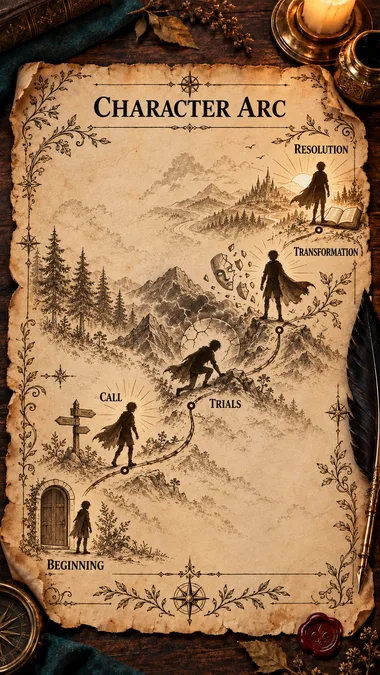
Start from the wound, not the end quality
We often think about the arc backwards: "I want him to become brave." Start instead from his starting wound: why isn't he already brave? A fear, a false belief about himself, a past experience. Take Ebenezer Scrooge, in Dickens's A Christmas Carol: his greed isn't an arbitrary trait, it comes from a specific wound, an abandonment and a poverty lived in childhood that convinced him only money offers real security. It's that wound, more than the targeted quality, that gives substance to the whole trajectory.
Give them a false solution before the real one
At the start of the story, your character deals with their wound in a bad way, but one that seems to work for them: they avoid, they control, they shut down. Scrooge's greed is a good example: it protects him, in a way, from the vulnerability that hurt him as a child, but it also cuts him off from any human connection. The plot needs to make this false solution less and less sustainable, until they have no choice but to try something else.
The turning point has to cost something
The moment a character changes should never be free. It has to cost them something real, giving up a protection, facing what they'd been avoiding from the start. For Scrooge, it isn't a simple change of mind: he has to admit the scale of what his greed cost him, which is a real renunciation, not a last-minute line. A character change that cost nothing always rings artificial to the reader.
The arc doesn't have to be positive
Not every character improves. A negative arc, where the character ultimately gives in to their worst tendency, can be just as powerful, as long as the trajectory is just as clear and earned as in a positive arc. Michael Corleone, in The Godfather, starts out specifically wanting not to become like his family; his arc leads him exactly where he refused to go at the start, and that reversed direction, just as coherent as a positive arc, is what makes it memorable.
A flat arc can also be the right choice
Some characters aren't meant to change, and that's not a writing flaw. Sherlock Holmes stays fundamentally the same from the first story to the last: his constancy is exactly what lets him serve as a fixed point around which other characters evolve. A flat arc is only a problem when it's unintentional, on a character meant to carry the story's emotional weight.
Check consistency across the whole manuscript
A character arc is built scene by scene, which makes it easy to lose track of over an entire novel. Reread only the scenes involving this character, in order, to check that their progression stays logical from one chapter to the next.
Happy writing!
Frequently asked questions
Does a novel need an arc for every character?
No, only for the main characters. Secondary characters can stay perfectly constant throughout the story without it being a problem.
Can there be more than one turning point?
Yes, especially in a long novel. Real change rarely happens all at once; several small turning points moving in the same direction are often more believable than a single revelation scene.
How do I know if my arc is too predictable?
If you can guess the end of the arc within the first quarter of the novel with no doubt at all, that's a good signal to introduce a setback or a relapse before the final resolution.