
Comment construire un arc de personnage crédible dans un roman
Dernière mise à jour : septembre 2026
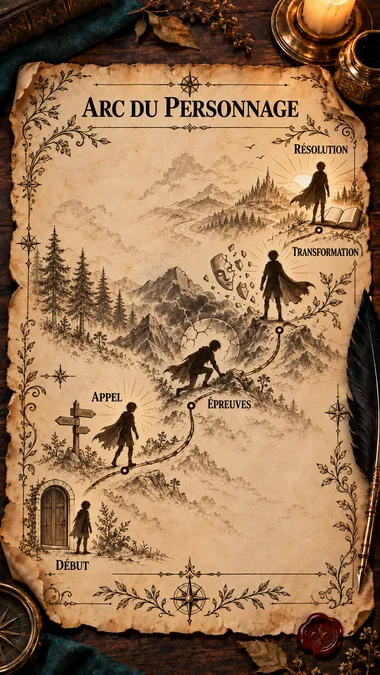
Une intrigue peut être parfaitement construite et laisser malgré tout un goût d'inachevé, si le personnage principal en ressort exactement le même qu'au début. L'arc de transformation, c'est ce qui donne l'impression que l'histoire valait la peine d'être vécue, pas seulement racontée.
How to Build a Believable Character Arc in a Novel
Last updated: September 2026
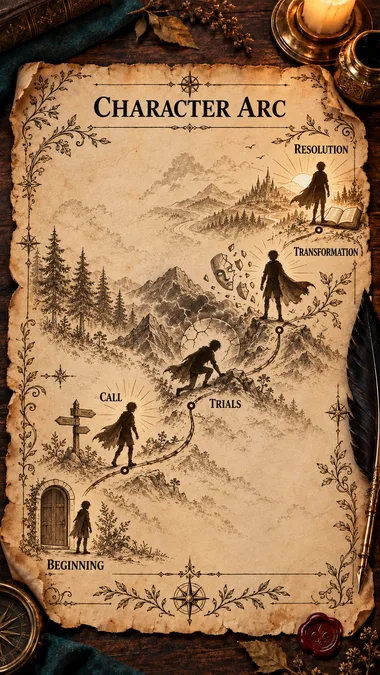
A plot can be perfectly constructed and still leave a sense of something unfinished, if the main character comes out exactly the same as they went in. The transformation arc is what makes a story feel like it was worth living through, not just recounting.
Partez de la blessure, pas de la qualité finale
On pense souvent l'arc à l'envers : « je veux qu'il devienne courageux ». Partez plutôt de sa blessure de départ : pourquoi n'est-il pas déjà courageux ? Une peur, une croyance fausse sur lui-même, une expérience passée. Prenez Ebenezer Scrooge, dans Un chant de Noël de Dickens : son avarice n'est pas un trait gratuit, elle vient d'une blessure précise, un abandon et une pauvreté vécus dans l'enfance qui l'ont convaincu que seul l'argent offre une sécurité réelle. C'est cette blessure, plus que la qualité visée, qui donne de la substance à toute la trajectoire.
Donnez-lui une fausse solution avant la vraie
Au début de l'histoire, votre personnage gère sa blessure d'une mauvaise façon, mais qui semble fonctionner pour lui : il évite, il contrôle, il se referme. L'avarice de Scrooge en est un bon exemple : elle le protège, dans un sens, de la vulnérabilité qui l'a blessé enfant, mais elle le coupe aussi de tout lien humain. L'intrigue doit rendre cette fausse solution de moins en moins tenable, jusqu'à ce qu'il n'ait plus le choix que d'essayer autre chose.
Le point de bascule doit coûter quelque chose
Le moment où le personnage change ne devrait jamais être gratuit. Il doit lui coûter quelque chose de réel, renoncer à une protection, affronter ce qu'il évitait depuis le début. Pour Scrooge, ce n'est pas un simple changement d'avis : il doit admettre l'ampleur de ce que son avarice lui a fait perdre, ce qui est un vrai renoncement, pas une réplique de dernière minute. Un changement de personnage qui n'a rien coûté sonne toujours artificiel aux yeux du lecteur.
L'arc n'a pas besoin d'être positif
Tous les personnages ne s'améliorent pas. Un arc négatif, où le personnage cède finalement à sa pire tendance, peut être tout aussi puissant, à condition que la trajectoire soit tout aussi claire et méritée que dans un arc positif. Michael Corleone, dans Le Parrain, commence en voulant précisément ne pas devenir comme sa famille ; son arc le mène exactement là où il refusait d'aller au début, et c'est cette direction inversée, tout aussi cohérente qu'un arc positif, qui le rend mémorable.
Un arc plat peut aussi être le bon choix
Certains personnages ne sont pas censés changer, et ce n'est pas un défaut d'écriture. Sherlock Holmes reste fondamentalement le même du premier au dernier récit : sa constance est précisément ce qui lui permet de servir de point fixe autour duquel les autres personnages, eux, évoluent. Un arc plat n'est un problème que lorsqu'il est involontaire, sur un personnage censé porter le poids émotionnel de l'histoire.
Vérifiez la cohérence sur l'ensemble du manuscrit
Un arc de personnage se construit scène après scène, ce qui le rend facile à perdre de vue sur un roman entier. Relisez uniquement les scènes qui impliquent ce personnage, dans l'ordre, pour vérifier que sa progression reste logique d'un chapitre à l'autre.
Bonne écriture !
Questions fréquentes
Un roman a-t-il besoin d'un arc pour chaque personnage ?
Non, seulement pour les personnages principaux. Les personnages secondaires peuvent très bien rester constants tout au long de l'histoire sans que ça pose problème.
Peut-on avoir plusieurs points de bascule ?
Oui, surtout sur un roman long. Un vrai changement se fait rarement d'un coup ; plusieurs petites bascules qui vont dans la même direction sont souvent plus crédibles qu'une seule scène de révélation.
Comment savoir si mon arc est trop prévisible ?
Si vous pouvez deviner la fin de l'arc dès le premier quart du roman sans aucun doute possible, c'est un bon signal pour introduire un revers ou une rechute avant la résolution finale.
Start from the wound, not the end quality
We often think about the arc backwards: "I want him to become brave." Start instead from his starting wound: why isn't he already brave? A fear, a false belief about himself, a past experience. Take Ebenezer Scrooge, in Dickens's A Christmas Carol: his greed isn't an arbitrary trait, it comes from a specific wound, an abandonment and a poverty lived in childhood that convinced him only money offers real security. It's that wound, more than the targeted quality, that gives substance to the whole trajectory.
Give them a false solution before the real one
At the start of the story, your character deals with their wound in a bad way, but one that seems to work for them: they avoid, they control, they shut down. Scrooge's greed is a good example: it protects him, in a way, from the vulnerability that hurt him as a child, but it also cuts him off from any human connection. The plot needs to make this false solution less and less sustainable, until they have no choice but to try something else.
The turning point has to cost something
The moment a character changes should never be free. It has to cost them something real, giving up a protection, facing what they'd been avoiding from the start. For Scrooge, it isn't a simple change of mind: he has to admit the scale of what his greed cost him, which is a real renunciation, not a last-minute line. A character change that cost nothing always rings artificial to the reader.
The arc doesn't have to be positive
Not every character improves. A negative arc, where the character ultimately gives in to their worst tendency, can be just as powerful, as long as the trajectory is just as clear and earned as in a positive arc. Michael Corleone, in The Godfather, starts out specifically wanting not to become like his family; his arc leads him exactly where he refused to go at the start, and that reversed direction, just as coherent as a positive arc, is what makes it memorable.
A flat arc can also be the right choice
Some characters aren't meant to change, and that's not a writing flaw. Sherlock Holmes stays fundamentally the same from the first story to the last: his constancy is exactly what lets him serve as a fixed point around which other characters evolve. A flat arc is only a problem when it's unintentional, on a character meant to carry the story's emotional weight.
Check consistency across the whole manuscript
A character arc is built scene by scene, which makes it easy to lose track of over an entire novel. Reread only the scenes involving this character, in order, to check that their progression stays logical from one chapter to the next.
Happy writing!
Frequently asked questions
Does a novel need an arc for every character?
No, only for the main characters. Secondary characters can stay perfectly constant throughout the story without it being a problem.
Can there be more than one turning point?
Yes, especially in a long novel. Real change rarely happens all at once; several small turning points moving in the same direction are often more believable than a single revelation scene.
How do I know if my arc is too predictable?
If you can guess the end of the arc within the first quarter of the novel with no doubt at all, that's a good signal to introduce a setback or a relapse before the final resolution.