
How to Create a Complete Character Sheet for a Novel
Last updated: September 2026
You've probably lived this scene: by chapter 12, you can't remember whether your secondary character has brown or green eyes, or why he hates his brother so much. A character sheet isn't a homework assignment to fill out before you write: it's a tool for staying consistent across 300 pages without memorizing everything.
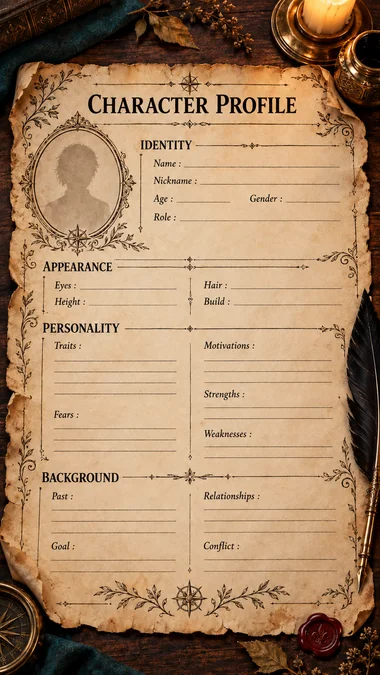
Not every character needs the same treatment. Protagonist, antagonist, secondary character, or simple foil: the more central the role in the plot, the more the sheet is worth developing. Here's what matters first, whatever the role.
Start with the essentials, not the physical description
Many character sheet templates start with eye color and height. Start instead with what actually moves the story forward: what does this character want, what's stopping them, and what are they afraid of. The physical description can be settled in one line at the end; it's those three answers that determine how they'll react in every scene.
Write down a contradiction or a flaw
A character with no flaw rings hollow. A contradiction, even a small one (someone generous but unable to ask for help, for example), makes the character believable and gives you material for scenes that put them on edge.
How many flaws and strengths should they have?
A single isolated flaw often reads as an excuse rather than a real weakness. Aim for several concrete flaws, not necessarily a long list, but enough that none of them feels decorative, and just as many real strengths to avoid the opposite effect: a character defined only by what's wrong with them. Balance matters more than the exact number; a character worth caring about needs both to feel human.
The special case of the antagonist
A believable antagonist needs their own sheet, with the same rigor as your protagonist. Their narrative role is to create contrast, not to embody evil for its own sake: give them a motivation that makes sense from their own point of view, even when it clashes with the hero's. An antagonist who believes they're in the right is almost always more memorable than one who's simply bad.
Define their relationship to the other main characters
A character never exists alone in the story. For each important relationship, write down what this character actually thinks of the other, not just their official tie (brother, coworker, rival). It's often the gap between the two that creates the best dialogue scenes.
The character's voice: vocabulary and register
Two characters who speak exactly the same way start blending together in dialogue. Vocabulary, sentence length, and register (casual, formal, technical) should shift based on each character's era, region, social class, or education. Note a few speech quirks on each sheet: a favorite phrase, a word they avoid, a particular way of cutting off their sentences. These are the details that make dialogue recognizable even without the tags.
Letting your character evolve as the plot unfolds
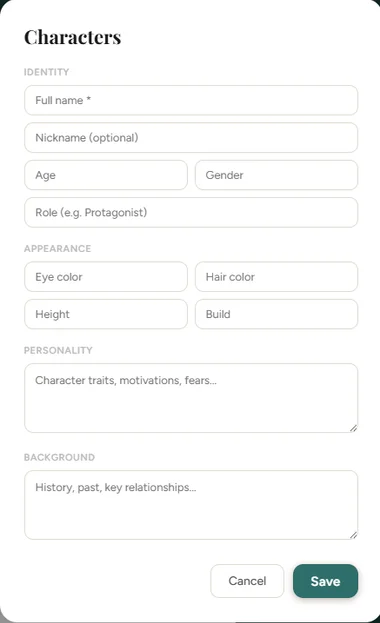
The sheet you fill out before writing describes the character in chapter one, not in the last chapter. Most main characters change: they gain a strength they were missing, lose an illusion, or give up something they thought they wanted. Note, even loosely, where this character starts and what might be different by the end. In Inkbound, it's easy to come back to a character's sheet as the story moves forward to keep track of that change, instead of only noticing it once the finished manuscript gets a re-read.
Physical details worth remembering
Once the character feels alive on paper, a few physical details are worth noting: a particular way of walking, a recurring tic or gesture, a clothing style, something about their voice. Not to fill in a box first, but because these small concrete details, more than eye color, are often what make a character visualizable for the reader.
Leave room for what you don't know yet
A character sheet doesn't need to be complete before you start writing. Leave fields blank, to fill in as you go. A character who reveals themselves while you write is often more alive than one fully planned in advance.
Happy writing!
Frequently asked questions
Do you need to fill out the sheet before writing the first chapter?
Not necessarily in full. The broad strokes (motivation, flaw, main relationships) help from the start, but the details can come into focus as you write.
How many characters need a complete sheet?
Mainly your main characters and antagonists. For secondary characters, a few lines are often enough: their role, one defining trait, and their tie to the plot.
What if my character changes while I'm writing?
Update the sheet instead of treating it as fixed. A character evolving as you write is normal, and sometimes even a sign that the story is coming alive.