
Worldbuilding: The Basics for Building a Coherent World
Last updated: September 2026
Building a world can quickly become a bottomless pit: you can spend months on it without ever writing a single scene. Worldbuilding isn't an end in itself though, it's a tool that serves the story. Here's how to lay solid foundations without losing yourself in them.
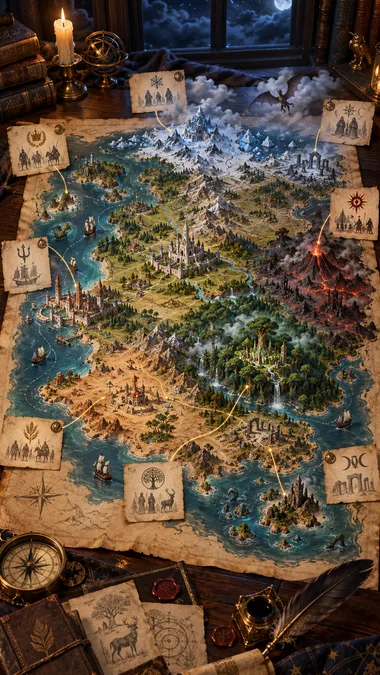
Only build what the story will touch
You don't need to know the complete political history of a country your characters will never visit. Prioritize the elements the plot will actually use: the system that limits your characters, the place where key scenes happen, the rules that create concrete stakes. That's the iceberg principle: what your readers see is only a fraction of what you know, and that's exactly how it should be.
Give your world limits, not just rules
A world becomes interesting mostly through what it prevents, not just what it allows. A society with a strict hierarchy, a scarce resource, an unjust law: these are the limits that naturally create conflict and hard choices for your characters.
Connect geography, economy and culture
A desert rarely produces a culture obsessed with fishing. Checking the consistency between the environment, how people make a living, and the beliefs that follow from it avoids the most visible inconsistencies, the ones readers notice first.
Distill information instead of explaining it in one block
Worldbuilding's worst enemy is the long explanatory paragraph at the start of a novel. The Lord of the Rings never explains Hobbit habits head-on: you discover them through their meals, their quirks, their conversations, long before any narrator describes them to you. Let your own details surface naturally through action, dialogue, and characters' reactions, rather than through a frontal explanation.
Happy writing!
Frequently asked questions
Do you need to build everything before you start writing?
No. Many authors build their world alongside the writing, adding details only when the story calls for them. That's often more effective than planning everything in advance.
How do you avoid inconsistencies in a long novel?
By centralizing the important rules in one place, checked every time a new scene involves them, rather than relying on memory as the chapters go on.
Is worldbuilding only useful for fantasy and sci-fi?
No. Even a contemporary novel needs a minimum of consistency in its setting: the social rules of a workplace, the geography of a made-up city, or a family's habits all count as worldbuilding too.