
Three-Act Structure, Save the Cat, or the Snowflake Method: Which One?
Last updated: September 2026
You've decided to outline your novel, good news. Bad news: there are a good dozen different methods out there, each with defenders convinced theirs is the only one that actually works. Here are the three most used, what they actually give you, and how to figure out which one fits without testing all of them one by one.
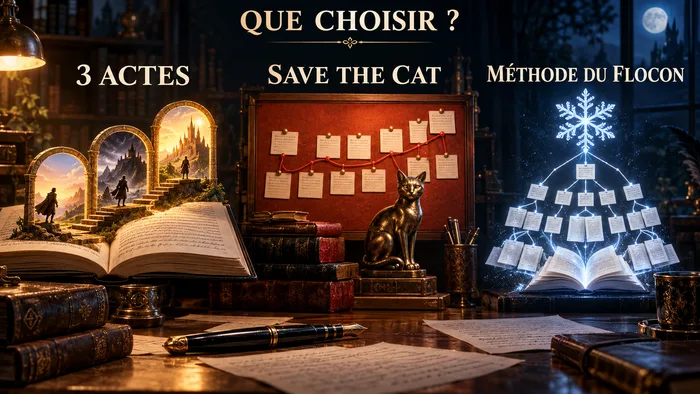
Three-act structure
This is the oldest and simplest: setup, complications, resolution. Act 1 introduces your characters and world, act 2 is where everything gets more complicated (and makes up roughly half the novel), act 3 settles the score. It doesn't tell you what to put in each act, only where to place the major hinges. It's a good starting point if you're new to outlining: enough structure to avoid getting lost, enough freedom to avoid feeling boxed in.
Save the Cat
Created by screenwriter Blake Snyder and later adapted for novels by Jessica Brody in Save the Cat! Writes a Novel, this one goes much further into detail: 15 precise beats, each with an approximate page range (the inciting incident around 12%, the midpoint at 50%, all is lost around 75%). It's reassuring if you like knowing exactly where you stand, but it can also turn into a cage if you force your story to hit every beat in the right order. Use it as a map, not as a mandatory itinerary.
The Snowflake method
Developed by physicist and novelist Randy Ingermanson, this one is completely different in spirit: you start from a single sentence, expand it into a paragraph, then a page, then an increasingly detailed scene list, the way a snowflake grows more complex layer by layer. It's the most gradual of the three, ideal if the idea of a ten-page outline all at once paralyzes you more than it helps.
The hero's journey: the fourth reference
Search for outlining methods long enough and you'll almost always run into a fourth reference: the hero's journey, popularized by Christopher Vogler building on Joseph Campbell's work on myth. It breaks a story into about a dozen symbolic stages (the call to adventure, crossing the threshold, the ordeal, the transformed return), originally meant for coming-of-age and quest narratives. It isn't a competitor to the three methods above so much as a separate language, more mythological than practical, that quietly runs underneath a lot of fantasy and adventure fiction without needing to be followed to the letter. Worth knowing to understand why some stories feel familiar, less useful as a day-to-day planning tool.
The three methods (and the hero's journey) at a glance
Before you choose, here are the four main references side by side, to quickly compare their logic and who each one suits best.
| Method | Creator | Structure | Best if... |
|---|---|---|---|
| Three acts | Classical origin (theater) | 3 acts, no fixed steps | you're new to outlining |
| Save the Cat | Blake Snyder / Jessica Brody | 15 beats with % markers | you like knowing exactly where you stand |
| Snowflake method | Randy Ingermanson | Sentence → paragraph → scenes | a detailed outline all at once paralyzes you |
| Hero's journey | Christopher Vogler / Joseph Campbell | ~12 symbolic stages | you're writing a quest or coming-of-age story |
How to choose without wasting time
The table above gives you the big picture; here's how to decide without wasting time. Ask yourself one question: what do you need to avoid getting stuck once you're at the page, too much freedom or too little? If you tend to scatter in every direction, Save the Cat will give you guardrails. If you already feel boxed in just thinking about it, three-act structure or the snowflake method will give you more room to breathe.
Combining methods without losing your way
Nothing forces you to pick one method and stick to it the whole way through. A common combination: use the snowflake method to lay down the macro-structure (the sentence, then the paragraph, then the page that summarizes the novel), then bring in Save the Cat's beats when it's time to detail the scene list, to check that the major hinges land in the right place. Three-act structure, meanwhile, mostly works as a reading grid after the fact, letting you check that each act is doing its job once the outline exists, without needing to actively follow it during planning. In Inkbound's chapter editor, each beat or stage can become a chapter or a linked note, which makes mixing methods easier to track than a plain text document.
The mistakes that waste time
Three traps show up often, whatever method you pick. The first: planning paralysis, when polishing the outline becomes a way to avoid writing the novel itself. There comes a point where the outline is good enough, not perfect, and that's enough to start. The second: mechanical rigidity, checking off every beat or stage without asking whether it actually serves this particular story; a method stays a tool, not a contract. The third: over-planning, detailing every scene until you no longer feel like writing them, the story having already been "lived" on paper. Recognizing one of these traps is often the sign that it's time to stop planning and start writing.
Happy writing!
Frequently asked questions
Can you switch methods partway through a novel?
Yes, no problem. A method that stops working for you at chapter 10 doesn't invalidate what you've already written. Plenty of writers adjust their approach once the first third of the novel is down.
Do you have to follow Save the Cat's percentages to the letter?
No. They're reference points, not absolute rules. A midpoint at 47% or 53% won't derail your story.
What if none of these three methods works for you?
That's fine. These three are the best-known, but others exist, and you can absolutely invent a hybrid of your own. The only thing that matters is that it helps you write, not that it carries a recognized name.