
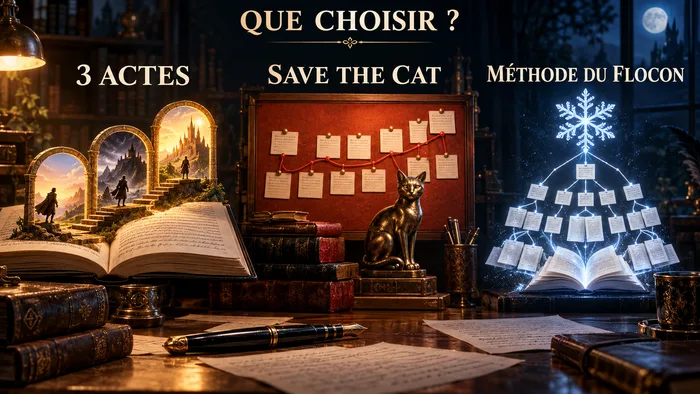
3 actes, Save the Cat ou méthode du flocon : que choisir ?
Dernière mise à jour : septembre 2026
Vous avez décidé de planifier votre roman, bonne nouvelle. Mauvaise nouvelle : il existe une bonne dizaine de méthodes différentes, chacune avec ses défenseurs convaincus que c'est la seule qui fonctionne vraiment. Voici les trois plus utilisées, ce qu'elles apportent concrètement, et comment savoir laquelle vous convient sans toutes les tester une par une.
Three-Act Structure, Save the Cat, or the Snowflake Method: Which One?
Last updated: September 2026
You've decided to outline your novel, good news. Bad news: there are a good dozen different methods out there, each with defenders convinced theirs is the only one that actually works. Here are the three most used, what they actually give you, and how to figure out which one fits without testing all of them one by one.
La structure en trois actes
C'est la plus ancienne et la plus simple : situation initiale, complications, résolution. Un acte 1 qui pose vos personnages et votre monde, un acte 2 où tout se complique (et qui représente environ la moitié du roman), un acte 3 qui règle les comptes. Elle ne vous dit pas quoi mettre dans chaque acte, seulement où poser les grandes charnières. C'est un bon point de départ si vous découvrez la planification : assez de structure pour ne pas vous perdre, assez de liberté pour ne pas vous sentir enfermé.
Save the Cat
Créée par le scénariste Blake Snyder puis adaptée au roman par Jessica Brody dans Save the Cat! Writes a Novel, cette méthode va beaucoup plus loin dans le détail : 15 beats précis, avec une fourchette de pages indicative pour chacun (l'incident déclencheur vers 12 %, le point médian à 50 %, tout semble perdu vers 75 %). C'est rassurant si vous aimez savoir exactement où vous en êtes, mais ça peut aussi devenir une cage si vous forcez votre histoire à cocher chaque case dans le bon ordre. À utiliser comme une carte, pas comme un itinéraire imposé.
La méthode du flocon (Snowflake)
Mise au point par le physicien et romancier Randy Ingermanson, cette méthode est complètement différente dans l'esprit : vous partez d'une phrase, que vous développez en paragraphe, puis en page, puis en plan de scènes de plus en plus détaillé — comme un flocon de neige qui se complexifie couche par couche. C'est la méthode la plus progressive des trois, idéale si l'idée d'un plan de dix pages d'un coup vous paralyse plus qu'elle ne vous aide.
Le voyage du héros, la 4e piste
Vous croiserez presque toujours une quatrième référence en cherchant des méthodes de plan : le voyage du héros, popularisé par Christopher Vogler à partir des travaux de Joseph Campbell sur le mythe. Il découpe l'histoire en une douzaine d'étapes symboliques (l'appel de l'aventure, le franchissement du seuil, l'épreuve suprême, le retour transformé), pensées à l'origine pour des récits d'apprentissage et de quête. Ce n'est pas une méthode concurrente aux trois précédentes : c'est plutôt un langage à part, plus mythologique que pratique, qui infuse en arrière-plan beaucoup de fantasy et d'aventure sans qu'on ait besoin de le suivre à la lettre. Utile pour comprendre pourquoi certaines histoires vous semblent familières, moins utile comme outil de planification au quotidien.
Les trois méthodes (et le voyage du héros) en un coup d'œil
Avant de choisir, voici les quatre repères principaux réunis d'un coup d'œil, pour comparer rapidement leur logique et à qui chacune convient le mieux.
| Méthode | Créateur | Structure | Idéale si... |
|---|---|---|---|
| 3 actes | Origine classique (théâtre) | 3 actes, pas d'étapes fixes | vous découvrez la planification |
| Save the Cat | Blake Snyder / Jessica Brody | 15 beats avec repères en % | vous aimez savoir où vous en êtes |
| Méthode du flocon | Randy Ingermanson | Phrase → paragraphe → scènes | un plan détaillé d'un coup vous paralyse |
| Voyage du héros | Christopher Vogler / Joseph Campbell | ~12 étapes symboliques | vous écrivez une quête ou un récit initiatique |
Comment choisir sans perdre de temps
Le tableau ci-dessus donne une vue d'ensemble ; voici maintenant comment trancher sans perdre de temps. Posez-vous une seule question : de quoi avez-vous besoin pour ne pas bloquer une fois devant la page, trop de liberté ou trop peu ? Si vous avez tendance à vous éparpiller, Save the Cat vous donnera des garde-fous. Si vous vous sentez déjà à l'étroit rien qu'en y pensant, la structure en trois actes ou la méthode du flocon vous laisseront plus d'air.
Combiner les méthodes sans se perdre
Rien n'oblige à choisir une seule méthode et à s'y tenir jusqu'au bout. Une combinaison courante : utiliser la méthode du flocon pour poser la macro-structure (la phrase, puis le paragraphe, puis la page qui résume le roman), puis injecter les beats de Save the Cat au moment de détailler la liste de scènes, pour vérifier que les grandes charnières tombent au bon endroit. La structure en trois actes, elle, sert surtout de grille de lecture une fois le plan fait, pour vérifier que chaque acte fait son travail, sans avoir à la suivre activement pendant la planification. Dans l'éditeur de chapitres d'Inkbound, chaque beat ou étape peut devenir un chapitre ou une note liée, ce qui rend ce mélange de méthodes plus facile à suivre qu'un simple document texte.
Les erreurs qui font perdre du temps
Trois pièges reviennent souvent, peu importe la méthode choisie. Le premier : la paralysie de planification, quand peaufiner le plan devient une façon d'éviter d'écrire le roman lui-même. Il vient un moment où le plan est assez bon, pas parfait, et c'est suffisant pour commencer. Le deuxième : la rigidité mécanique, cocher chaque beat ou étape sans se demander s'il sert vraiment cette histoire précise ; une méthode reste un outil, pas un contrat. Le troisième : la sur-planification, détailler chaque scène au point de ne plus avoir envie de les écrire, l'histoire ayant déjà été « vécue » sur le papier. Reconnaître l'un de ces pièges est souvent le signe qu'il est temps d'arrêter de planifier et de commencer à écrire.
Bonne écriture !
Questions fréquentes
Peut-on changer de méthode en cours de roman ?
Oui, sans problème. Une méthode qui ne vous convient plus au chapitre 10 n'invalide pas ce que vous avez déjà écrit. Beaucoup d'auteurs ajustent leur approche une fois le premier tiers du roman posé.
Faut-il absolument suivre les pourcentages de Save the Cat à la lettre ?
Non. Ce sont des repères, pas des règles absolues. Un point médian à 47 % ou 53 % ne fera pas dérailler votre histoire.
Et si aucune de ces trois méthodes ne me convient ?
Ce n'est pas grave. Ces trois-là sont les plus connues, mais il en existe d'autres, et vous pouvez tout à fait vous en inventer une hybride. Le seul critère qui compte, c'est qu'elle vous aide à écrire, pas qu'elle porte un nom reconnu.
Three-act structure
This is the oldest and simplest: setup, complications, resolution. Act 1 introduces your characters and world, act 2 is where everything gets more complicated (and makes up roughly half the novel), act 3 settles the score. It doesn't tell you what to put in each act, only where to place the major hinges. It's a good starting point if you're new to outlining: enough structure to avoid getting lost, enough freedom to avoid feeling boxed in.
Save the Cat
Created by screenwriter Blake Snyder and later adapted for novels by Jessica Brody in Save the Cat! Writes a Novel, this one goes much further into detail: 15 precise beats, each with an approximate page range (the inciting incident around 12%, the midpoint at 50%, all is lost around 75%). It's reassuring if you like knowing exactly where you stand, but it can also turn into a cage if you force your story to hit every beat in the right order. Use it as a map, not as a mandatory itinerary.
The Snowflake method
Developed by physicist and novelist Randy Ingermanson, this one is completely different in spirit: you start from a single sentence, expand it into a paragraph, then a page, then an increasingly detailed scene list, the way a snowflake grows more complex layer by layer. It's the most gradual of the three, ideal if the idea of a ten-page outline all at once paralyzes you more than it helps.
The hero's journey: the fourth reference
Search for outlining methods long enough and you'll almost always run into a fourth reference: the hero's journey, popularized by Christopher Vogler building on Joseph Campbell's work on myth. It breaks a story into about a dozen symbolic stages (the call to adventure, crossing the threshold, the ordeal, the transformed return), originally meant for coming-of-age and quest narratives. It isn't a competitor to the three methods above so much as a separate language, more mythological than practical, that quietly runs underneath a lot of fantasy and adventure fiction without needing to be followed to the letter. Worth knowing to understand why some stories feel familiar, less useful as a day-to-day planning tool.
The three methods (and the hero's journey) at a glance
Before you choose, here are the four main references side by side, to quickly compare their logic and who each one suits best.
| Method | Creator | Structure | Best if... |
|---|---|---|---|
| Three acts | Classical origin (theater) | 3 acts, no fixed steps | you're new to outlining |
| Save the Cat | Blake Snyder / Jessica Brody | 15 beats with % markers | you like knowing exactly where you stand |
| Snowflake method | Randy Ingermanson | Sentence → paragraph → scenes | a detailed outline all at once paralyzes you |
| Hero's journey | Christopher Vogler / Joseph Campbell | ~12 symbolic stages | you're writing a quest or coming-of-age story |
How to choose without wasting time
The table above gives you the big picture; here's how to decide without wasting time. Ask yourself one question: what do you need to avoid getting stuck once you're at the page, too much freedom or too little? If you tend to scatter in every direction, Save the Cat will give you guardrails. If you already feel boxed in just thinking about it, three-act structure or the snowflake method will give you more room to breathe.
Combining methods without losing your way
Nothing forces you to pick one method and stick to it the whole way through. A common combination: use the snowflake method to lay down the macro-structure (the sentence, then the paragraph, then the page that summarizes the novel), then bring in Save the Cat's beats when it's time to detail the scene list, to check that the major hinges land in the right place. Three-act structure, meanwhile, mostly works as a reading grid after the fact, letting you check that each act is doing its job once the outline exists, without needing to actively follow it during planning. In Inkbound's chapter editor, each beat or stage can become a chapter or a linked note, which makes mixing methods easier to track than a plain text document.
The mistakes that waste time
Three traps show up often, whatever method you pick. The first: planning paralysis, when polishing the outline becomes a way to avoid writing the novel itself. There comes a point where the outline is good enough, not perfect, and that's enough to start. The second: mechanical rigidity, checking off every beat or stage without asking whether it actually serves this particular story; a method stays a tool, not a contract. The third: over-planning, detailing every scene until you no longer feel like writing them, the story having already been "lived" on paper. Recognizing one of these traps is often the sign that it's time to stop planning and start writing.
Happy writing!
Frequently asked questions
Can you switch methods partway through a novel?
Yes, no problem. A method that stops working for you at chapter 10 doesn't invalidate what you've already written. Plenty of writers adjust their approach once the first third of the novel is down.
Do you have to follow Save the Cat's percentages to the letter?
No. They're reference points, not absolute rules. A midpoint at 47% or 53% won't derail your story.
What if none of these three methods works for you?
That's fine. These three are the best-known, but others exist, and you can absolutely invent a hybrid of your own. The only thing that matters is that it helps you write, not that it carries a recognized name.